How to Handle the 10 Most Common Objections on Inbound Calls (Without Sounding Salesy)
Inbound calls are gold—because the lead chose to reach out. But they also come with a predictable twist: the caller often opens with a “soft no” to protect their time, privacy, or options.
The good news? Most objections aren’t rejection. They’re a request for clarity, control, and a low-pressure next step.
Below are the 10 most common inbound objections real estate agents hear—plus practical scripts that feel natural, keep rapport, and move the call forward.
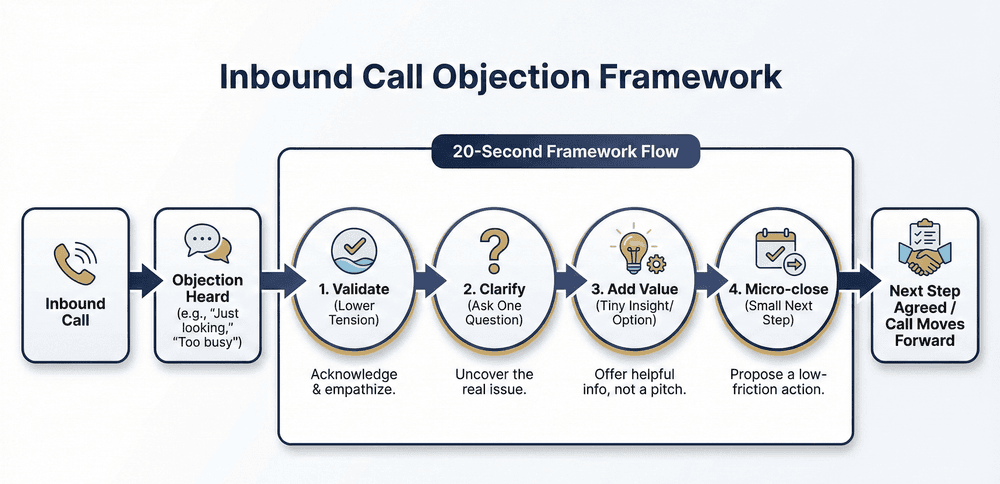
Your 20-second objection framework (use this every time)
When you get any objection, follow this simple flow:
- Validate (lower the tension)
- Clarify (ask one short question)
- Add value (tiny insight or option)
- Micro-close (small next step, not a big commitment)
Think: “Totally fair. Quick question. Here’s what I’d do. Want me to text/email that?”
The 10 Most Common Objections (with scripts)
1) “I’m just looking.”
What it usually means
They want info, not pressure—and they’re testing whether you’ll respect that.
Script
Agent: “Totally fair—most people start there. Just so I don’t spam you with irrelevant stuff, are you looking more for price research, neighborhoods, or timing?”
(Then mirror their answer.)
Agent: “Got it. If you’d like, I can send you a quick shortlist that matches what you’re browsing—no commitment. What’s the best number/email?”
Micro-close options
- “Want me to text you 3–5 options to compare?”
- “Would a quick 2-minute rundown of the area help?”
2) “We’re not ready yet.”
What it usually means
They’re early, uncertain, or afraid of being “sold.”
Script
Agent: “That makes sense. When people say ‘not ready,’ it’s usually either timing or missing info. Which one is it for you?”
If timing:
Agent: “Perfect—then we keep it simple. Want a quick plan for what to do between now and then so you’re not scrambling later?”
Micro-close
- “Want a checklist texted to you?”
- “Should we pencil a 10-minute call for when you’re closer?”
3) “I already have an agent.”
What it usually means
Sometimes true. Sometimes a brush-off. Sometimes they’re unhappy but loyal.
Script (respectful + diagnostic)
Agent: “Totally—glad you’re supported. Before I let you go, are you fully set with them for this move, or are you still comparing options?”
If fully set:
Agent: “Great. If anything changes, I’m happy to be a backup resource. Want me to text you my contact so you have it?”
If comparing:
Agent: “Makes sense. Quick question—what would you want your agent to be best at: negotiation, pricing strategy, or off-market opportunities?”
Micro-close
- “Want one second opinion on pricing or timing?”
- “If I send a quick market snapshot, would that help you compare?”
4) “I’m working with a lender already.”
What it usually means
They’re protecting their process—or they’ve had a bad experience with pushy referrals.
Script
Agent: “Perfect—that’s a big piece handled. Just to make sure you’re set up for success, have you already talked through monthly payment comfort and how competitive you need to be in offers right now?”
Agent: “If you want, I can coordinate with your lender so we’re aligned on timing and strategy.”
Micro-close
- “Want me to send a quick offer-strength checklist?”
- “Should I text you a ‘what wins in this market’ guide?”
5) “Can you just send me listings?”
What it usually means
They want convenience, but they don’t want a long conversation.
Script (short and efficient)
Agent: “Absolutely. I can send listings in about 60 seconds—just need two filters so it’s accurate:
- What area(s)?
- What’s your must-have: price cap, bedrooms, or property type?”
Agent: “And do you want only ‘new’ listings, or also homes that have been sitting (sometimes those are negotiable)?”
Micro-close
- “Text or email?”
- “Daily updates or just when something great hits?”
6) “I don’t want to give my number/email.”
What it usually means
They’ve been burned by follow-ups.
Script (give control)
Agent: “Fair—nobody wants to get hounded. If I send anything, it’ll be exactly what you asked for and you can opt out anytime. Would you prefer I text you one summary, or we keep it on this call?”
If they refuse entirely:
Agent: “No problem. Let’s do it now—what kind of home are you comparing?”
Micro-close
- “Want me to send just one message with the top 5 matches—yes or no?”
7) “I’m just calling around / shopping agents.”
What it usually means
They’re open—this is your moment to be calm, clear, and useful.
Script
Agent: “That’s smart. Most people pick the agent who gives them the clearest plan. What’s your situation—buying, selling, or both?”
Then:
Agent: “If you give me 30 seconds, I’ll tell you what I’d do first in your case. If it’s helpful, we can set a quick follow-up—if not, no harm.”
Micro-close
- “Want the 3-step plan for your scenario?”
- “Would a 10-minute consult be useful, or are you still gathering info?”
8) “I’m too busy right now.”
What it usually means
They’re overwhelmed. They want an easier path.
Script
Agent: “Totally get it. Let’s make this painless—what’s better:
- a 2-minute call right now, or
- I text you 3 questions and you reply when you can?”
If they choose later:
Agent: “Great—what time window usually works best for you, mornings or evenings?”
Micro-close
- “Text-first works?”
- “Want me to send a quick summary now and we book later?”
9) “Your commission / fees are too high.”
(or: “Can you discount?”)
What it usually means
They’re really asking: “What do I get for that?”
Script (value + outcome)
Agent: “I hear you. Quick question—are you most concerned about netting the most, selling fast, or reducing stress and risk?”
Then:
Agent: “My job is to protect your outcome—pricing strategy, negotiation, and keeping deals from falling apart. If I can show you a plan that aims to improve your net (or reduce risk), would you be open to a quick meeting?”
Micro-close
- “Want a net sheet estimate so we compare scenarios?”
- “If I bring a pricing strategy and marketing plan, would that be worth 15 minutes?”
Tip: Avoid debating commission on the phone too early. Bring it back to outcomes and a clear plan.
10) “We’re going to wait / the market is crazy.”
What it usually means
They’re anxious, unsure about rates/prices, and want reassurance.
Script
Agent: “Totally understandable—there’s a lot of noise. The real question is: are you waiting for rates, prices, or inventory?”
Then provide one grounded insight (no lecturing):
Agent: “Here’s what we can do: I can set you up with alerts and a simple ‘watch list’ so you’ll know when the right opportunity shows up—without having to constantly check.”
Micro-close
- “Want me to set that up and you can ignore it until something fits?”
- “Would you like a quick monthly check-in—yes or no?”
Pro moves that make objection-handling feel effortless
Keep your tone: calm, curious, and concise
Objections flare up when callers feel trapped. Your job is to give them control.
Use “either/or” choices
Instead of “Do you want to book an appointment?” try:
- “Text or email?”
- “2 minutes now or 10 minutes later?”
- “Neighborhood A or B?”
Confirm the next step out loud
Before hanging up:
- “Perfect—so I’m texting you the shortlist, and you’ll tell me which 2 you want to tour.”
Quick call opener you can use today
Try this at the start of inbound calls:
“Thanks for calling—what are you hoping to accomplish today?”
Then pause.
That single line invites intent, reduces defensiveness, and makes objections easier to handle because you’re solving their goal—not pushing yours.
Make this even easier with Keyra (AI assistant for inbound calls)
If you’re missing calls, juggling showings, or tired of repeating the same objection scripts all day, this is exactly where Keyra helps.
Keyra can:
- Answer inbound calls instantly
- Qualify the lead (timeline, location, budget, motivation)
- Handle common objections naturally
- Schedule meetings directly on your calendar
So instead of chasing callbacks, you spend your time with the leads who are actually ready—while still giving “just looking” callers a great experience.