Why your first lead call matters more than your fifth follow-up
New leads are basically produce: fresh is best.
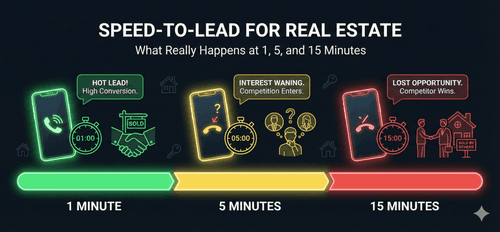
Multiple studies on inbound lead response show that speed dramatically changes outcomes—especially in that first 5–30 minutes window. The often-cited MIT/InsideSales “Lead Response Management” research found leads called within 5 minutes vs. 30 minutes were ~100x more likely to be contacted and ~21x more likely to be qualified.
And yet, many businesses still respond painfully slowly (or not at all). Harvard Business Review called this out years ago: most companies don’t respond nearly fast enough to online inquiries. InsideSales also reported average web-lead response times measured in dozens of hours, not minutes.
So the play isn’t “have the perfect script.”
It’s: respond fast + run a consistent conversation that earns a next step.
This post gives you an exact call flow and the questions that work—because each one does a job.
The New Lead Call Goal (say it out loud)
Your job on the first call is not to “sell yourself.”
It’s to earn a simple commitment:
Book the next step (showing, consult, lender intro, pricing consult)
or qualify out politely.
That’s it.
The 5-part call flow (simple, repeatable)
[Image: New lead call flow diagram]
1) Open + context (10–20 seconds)
Script
“Hi [Name]—it’s [You] with [Team/Brokerage]. You just reached out about [address / ‘homes in X’ / ‘selling in Y’]. Did I catch you at an okay time?”
Why it works:
- Mentions what they did (reduces “who is this?” friction)
- Asks permission (lowers resistance and keeps you out of pushy territory)
2) Permission + agenda (10 seconds)
Script
“Perfect. This’ll take two minutes. I’m going to ask a few quick questions so I don’t send you random listings—then we’ll decide the best next step. Sound good?”
Why it works:
This creates a micro-commitment and positions you as organized, not needy.
3) Discovery (3–6 minutes)
Here’s the exact question stack. Use it in order.
Exact questions to ask (and what each one actually does)
A. “What prompted you to start looking/selling now?”
Why it works:
This uncovers motivation (the real driver) and instantly tells you whether you’re speaking to a window-shopper, a problem-solver, or a deadline-driven mover.
Follow-up if vague:
- “What would have to happen for you to make a move?”
- “Is there a date you’re working around?”
B. “Are you buying, selling, or both?”
Why it works:
It determines your roadmap. “Both” means you’re managing sequencing, contingency risk, and stress—aka you become valuable fast.
C. “If we found the right fit, when would you want to move?”
(Then: “And when would you need to move?”)
Why it works:
Two timelines reveal urgency + flexibility. “Want” is aspiration. “Need” is truth.
D. “Have you already been looking at homes online? Any favorites?”
Why it works:
This gets them talking (easy question), gives you price/area signals, and helps you gauge whether they’re emotionally attached to a style or a specific neighborhood.
Bonus line:
“What do you like about those?”
This reveals values (schools, commute, light, layout, yard, etc.).
E. “What are your top 3 must-haves—and your dealbreakers?”
Why it works:
It forces clarity. Most leads are fuzzy. You’re the pro who helps them get specific.
Pro move: repeat it back:
“Got it—3 bed, home office, walkable, and no busy roads. Anything else that’s a hard no?”
F. “Where do you need to be location-wise—and what matters most there?”
(Commute, schools, transit, lifestyle, family, noise, parking)
Why it works:
People say “anywhere in the city” until you ask what their life requires.
G. “Who else is involved in the decision?”
Why it works:
Prevents the classic time-waster: “I just need to check with…” after you’ve done real work.
Follow-up:
“Awesome—should we include them on the next call/visit so we’re aligned?”
H. “Have you spoken with a lender yet? Are you pre-approved?”
Why it works:
This isn’t about grilling. It’s about protecting their outcome and your calendar.
If they’re not pre-approved:
“No worries—most people aren’t at first. Want me to connect you with a great lender so you know your numbers before you fall in love with a home?”
Why this phrasing works:
It frames pre-approval as emotional protection, not paperwork.
I. “How would you like to communicate—text, email, or calls?”
(and: “Best times?”)
Why it works:
You reduce missed connections and set expectations like a professional.
J. “Are you already working with an agent?”
Why it works:
You’re qualifying ethically (and legally). If yes, you can exit gracefully:
“Totally—then you’re in good hands. If anything changes, I’m happy to be a backup resource.”
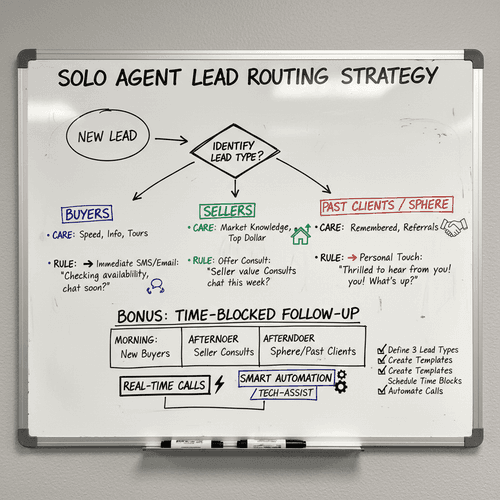
If it’s a SELLER lead: swap in these questions
Use the same opener + permission, then ask:
- “Where are you moving to next (if you sell)?”
- “What’s your ideal timeline?”
- “What updates have you done—and what condition is the home in today?”
- “Do you have a price in mind, or would you rather I bring comps and a range?”
- “If we could get you your ideal outcome, what would that look like?”
Why they work:
These questions uncover motivation, readiness, and expectation gaps—without arguing about price.
The clean close (book the appointment without being weird)
Here are two closes that consistently work.
Close #1: The “two options” close
“Based on what you told me, the fastest path is either:
A) a 15-minute buyer consult so I can set up a search and game plan, or
B) we jump straight to a showing of 2–3 homes this week.
Which do you prefer?”
Why it works:
You’re not asking if—you’re asking which.
Close #2: The “calendar drop” close
“I’ve got today at 6:15 or tomorrow at 12:20—what works?”
Why it works:
Specific times reduce the mental load and prevent the “I’ll get back to you.”
Objection handling (short, calm, effective)
[Image: New lead call script cheat sheet]
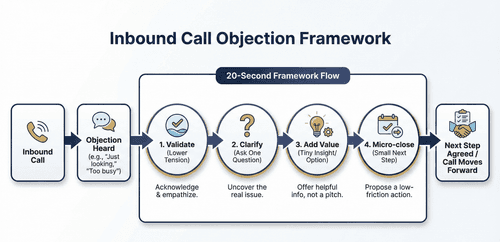
“I’m just browsing.”
“Totally. Most people start there. Quick question—are you browsing because you’re curious, or because you might move in the next 6–12 months?”
If “curious”:
“Got it. Want me to set you up with a no-spam search so you can watch the market without doing extra work?”
If “6–12 months”:
“Perfect—then a 10-minute plan call will save you a ton of time later. Want to do that this week?”
“Can you just email me listings?”
“Absolutely. Before I do—what are your top 3 must-haves and your dealbreakers? I’d rather not spam you with stuff you’d hate.”
“We’re talking to a few agents.”
“That makes sense. What are you hoping the right agent does for you that others haven’t?”
(Then listen. They just told you how to win.)
A quick “after-call” checklist (this is where deals are won)
Right after the call, send:
- A short recap text/email (“Here’s what I heard…”)
- The calendar invite (with location/Zoom link)
- The promised next thing (search link, lender intro, list of docs, showing plan)
This keeps momentum and reduces no-shows.
How Keyra fits into this (without changing your process)
If your biggest leak is missed calls or slow response, that’s exactly where an assistant earns its keep.
Keyra can:
- answer inbound calls immediately (even when you’re in a showing),
- run the exact question flow above to qualify the lead,
- capture clean notes (motivation, timeline, financing, areas),
- and schedule the next appointment on your calendar.
So you still get your personal touch—just without the “sorry I missed you” tax.
Copy/paste: the full “New Lead Call” script
Open
“Hi [Name]—it’s [You] with [Brokerage]. You just reached out about [X]. Did I catch you at an okay time?”
Permission
“This’ll take two minutes—mind if I ask a few quick questions so I can help the right way?”
Discovery
- “What prompted the move now?”
- “Buying, selling, or both?”
- “Want timeline vs need timeline?”
- “Any homes you’ve liked so far?”
- “Top 3 must-haves + dealbreakers?”
- “What matters most about location?”
- “Who else is involved in the decision?”
- “Have you spoken with a lender / pre-approved?”
- “Best way to communicate + best times?”
Close
“Best next step is either a quick consult or we schedule showings—what do you prefer?”
(or) “I have [two time options]—which works?”
One last reminder: speed beats perfection
The “perfect” script that happens tomorrow loses to the good call that happens in five minutes.