Speed-to-Lead for Real Estate: What Really Happens at 1, 5, and 15 Minutes
If you work in real estate, you already know speed-to-lead matters.
What most agents do not realize is how fast leads decay, or what actually changes between calling someone back in 1 minute versus 5 or 15. The difference is not subtle. It is often the difference between booking an appointment and quietly losing the deal to another agent who simply responded faster.
Let’s break down what really happens at each time window and why missed calls are one of the most expensive leaks in a real estate business.
What Is Speed-to-Lead (in Plain English)?
Speed-to-lead is how long it takes you to respond after a lead reaches out, whether that is:
- An inbound phone call
- A Zillow or Realtor.com inquiry
- A website form submission
- A “call me” request
In real estate, speed-to-lead usually comes down to one thing:
Did someone answer the phone when the lead called, or not?
High-intent buyers and sellers still pick up the phone first. Whoever engages them first usually wins.
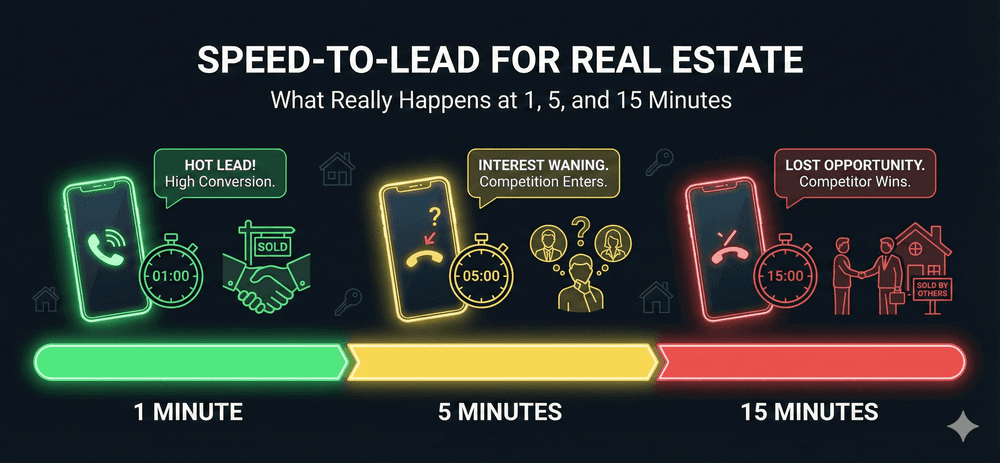
The 1-Minute Window: You Are Talking to the Decision-Maker
When you respond within 1 minute, you are usually the first real conversation that lead has.
What is happening in the lead’s head:
- They are actively thinking about buying or selling
- Their browser tab is still open
- Their phone is still in their hand
- Motivation is high
What this looks like for you:
- They answer the phone
- They talk freely and naturally
- They volunteer real details like timeline, budget, and motivation
- They are open to booking a next step
At this point, you are not following up.
You are simply continuing the conversation they just started.
This is where conversations feel easy. Seller leads explain their situation without being prompted. Buyer leads ask thoughtful questions. Mortgage shoppers are willing to share numbers.
If you have ever thought, “That call just flowed,” chances are you caught them in this window.
The 5-Minute Window: Interest Is Cooling, Competition Is Heating Up
At around 5 minutes, things begin to shift.
The lead is still valuable, but:
- They may have submitted multiple inquiries
- They may already be speaking with another agent or lender
- Emotional urgency has dropped
What you start noticing:
- They do not always answer unknown numbers
- Conversations are shorter and more guarded
- You hear more “just looking” or “still early”
Now you are no longer riding momentum.
You are rebuilding context.
You can absolutely still win business here, but it requires better scripts, better listening, and more follow-up discipline.
The hard truth is that most agents think they respond in 5 minutes. Between meetings, showings, and driving, it is often much longer.
The 15-Minute Window: You Are Officially Chasing
At 15 minutes or more, you are no longer responding.
You are interrupting.
What typically happens:
- Calls go to voicemail
- Texts are ignored
- Emails are skimmed or forgotten
And when you do connect:
- The lead sounds distracted
- They barely remember reaching out
- They are already working with someone else
This is where deals quietly die.
Not because the lead was bad.
Not because your pitch was weak.
But because someone else got there first.
From the lead’s perspective, the fastest responder feels:
- More professional
- More attentive
- More trustworthy
Speed becomes a shortcut for competence.
The Hidden Cost of Missed Calls
Here is the part most agents do not like to admit:
You do not lose leads because you are bad at real estate.
You lose leads because you are busy.
Busy with showings
Busy with clients
Busy driving
Busy with life
That is normal.
But when a call goes unanswered, the lead does not know why. All they know is that nobody picked up.
By the time you call back, the moment is gone.
Why Speed-to-Lead Is a System Problem, Not a Hustle Problem
Many agents try to solve speed-to-lead with:
- More reminders
- Tighter schedules
- More personal discipline
That works until it does not.
No human can:
- Answer every call
- Be available after hours
- Respond instantly while in another conversation
The agents who consistently win on speed-to-lead do not rely on willpower.
They rely on systems.
Systems that:
- Always answer the phone
- Always capture intent
- Always respond immediately
- Always notify you with context
When every inbound call is handled professionally, even when you are unavailable, speed-to-lead stops being a stress point and starts becoming a competitive advantage.
The Takeaway
If you remember nothing else, remember this:
- 1 minute: You are early. You control the conversation.
- 5 minutes: You are competing. Execution matters.
- 15 minutes: You are chasing. The odds are stacked against you.
Real estate is not just about market knowledge or negotiation skills.
It is about who shows up first.
If your current setup depends on you personally being available 100 percent of the time, that is not a strategy. It is a bottleneck.
And bottlenecks quietly kill growth.